
For decades, the public relations industry has hidden behind an analytics smokescreen. Traditional agencies love to hand executives monthly reports filled with “Potential Reach” or “Ad Value Equivalency” (AVE)—a deeply flawed metric that attempts to calculate what an earned media placement would cost if it were a paid advertisement. But AVE is an arbitrary fiction. You cannot take a report on media impressions to the bank to pay your corporate taxes, and you certainly cannot use it to fund your next operational expansion.
At AMM Communications, we believe that if you cannot connect your public relations presence directly to your business pipeline, your measurement framework is broken. Under our proprietary ARCHWAY ROI® system, we focus ruthlessly on the “R”— the true financial return. Here is the exact step-by-step framework to set up an airtight attribution system that tracks a prospect from a single earned media mention straight to a closed contract on your balance sheet.
Step 1: Set Up Digital Tracking Infrastructure (Eliminating the Blind Spots) You cannot track what you do not measure from the outset. Before any media pitch leaves your office or any guest column is published, your digital hub—your website—must be architected to capture inbound intent data.
• The Tracking Architecture: The majority of B2B buyers who see your executive team quoted in a trade publication or featured on an industry podcast will not click a direct link. Instead, they will open a new browser tab and search for your company name or the executive’s name directly. This is known as “Branded Search Traffic.” • The How-To: Configure custom conversion goals within your digital analytics platform. Specifically, isolate your organic branded search acquisition channels. When an earned media feature goes live, monitor this channel closely for the next 14 to 30 days. A high-performing PR placement should trigger a visible 15% to 20% spike in users landing on your site via your company name. This spike represents the direct, initial inbound traffic generated by your media presence.
Step 2: Implement “First-Touch” and “Last-Touch” Attribution in Your CRM B2B sales funnels are complex, often requiring multiple stakeholders and months of consideration. To find the true value of your PR, you must track how media wins introduce new prospects to your brand (First-Touch) and how they help close deals already in the pipeline (Last-Touch).
• The How-To (First-Touch): Update the forms on your website’s high-value landing pages (such as your “Request a Consultation” or lead magnet download pages). Add a mandatory text field that asks: “Where did you first hear about us?” While software tracks the technical click, human input captures the narrative. When a high-value prospect types in, “Saw your CEO’s interview in the Banking Journal,” that lead is immediately tagged in your CRM under the “PR/Earned Media” campaign bucket. • The How-To (Last-Touch): Document when a media placement revitalizes a cold lead. Train your sales team to log every instance where a prospect re-engages after being sent a piece of credibility collateral. If a deal that was stalled for 60 days suddenly moves to a signed contract after the sales rep shares a recent expert feature article, that media win earns last-touch attribution for closing that revenue.
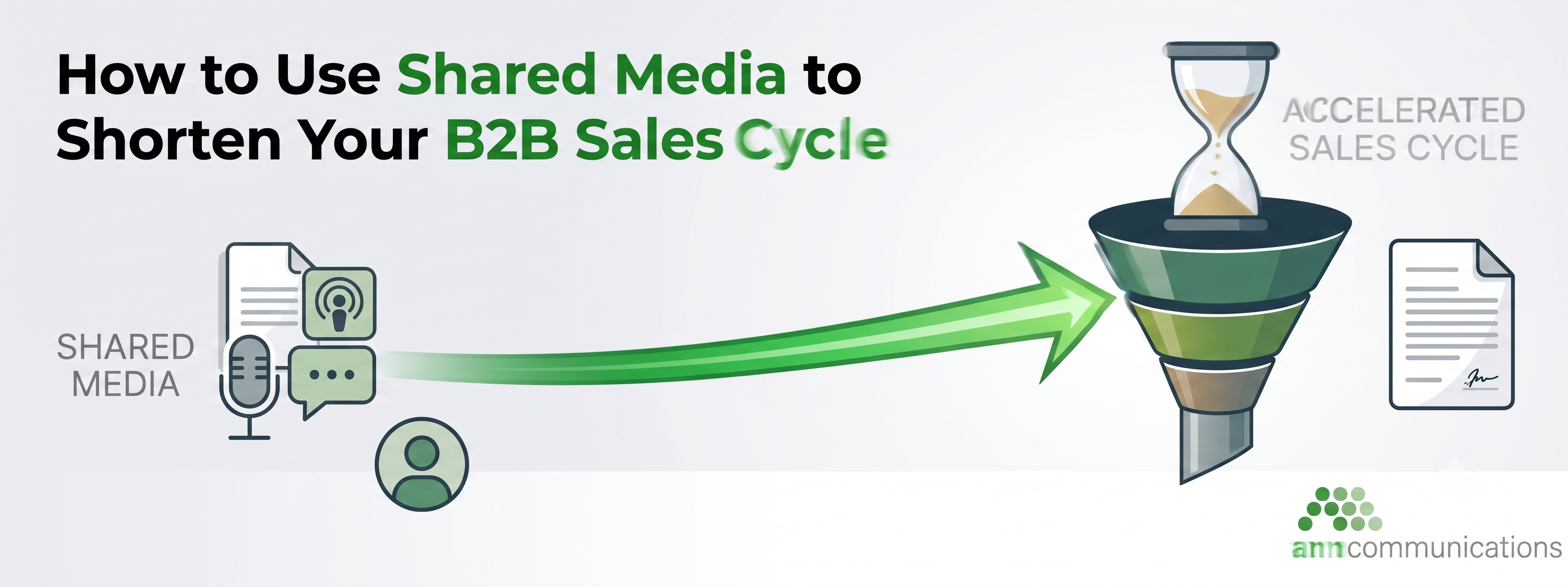
Step 3: Calculate the “Sales Velocity Dividend” True ROI is not just about the number of leads generated; it is also about the speed at which those leads move through your sales organization.
• The Financial Connection: When your brand possesses high authority, prospects spend less time interrogating your sales team about your capabilities and more time discussing scope and implementation. This compression of time increases your Sales Velocity, allowing your existing sales team to handle a higher volume of deals without increasing corporate overhead. • The How-To: Benchmark your historical average sales cycle length (e.g., 90 days from initial contact to signed contract). Once your ARCHWAY ROI® framework is deployed and your integrated PESO Model® is consistently positioning your firm as the market authority, isolate the leads that interacted with your earned and owned media content. Compare their sales cycle length against your benchmark. If the media-influenced leads close in 60 days instead of 90 days, that 33% increase in velocity represents a massive financial dividend that directly increases your quarterly cash flow.
Stop Paying for Vanity Metrics. Demand Clear Capital Attribution.
If your current agency’s reports stop at impressions and clicks, you are leaving your business growth to chance. At AMM Communications, we bring mathematical discipline and absolute budget clarity to the art of public relations. We help you build the digital pathways that transform public visibility into clear balance sheet assets. Ready to see the true financial return on your communications budget?
Contact AMM Communications today to schedule your ARCHWAY ROI® Strategy Session. Let us audit your analytical tracking systems and build an attribution engine that explicitly maps your visibility to your inbound revenue.