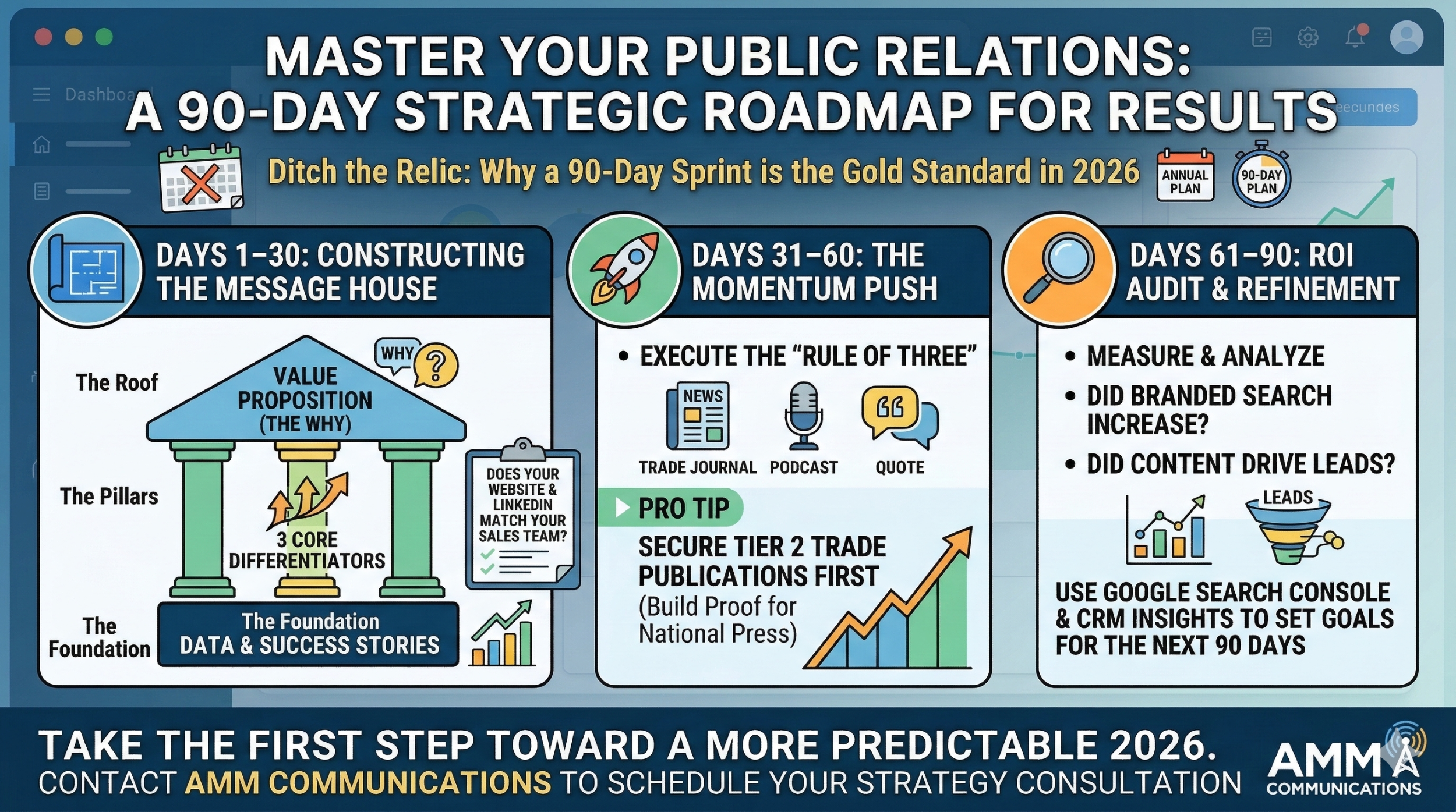
The “Annual Marketing Plan” is a relic of a slower era. In today’s market, a 90-Day Strategic Marketing Communications Plan is the gold standard. It provides a long enough runway to see real media traction but is nimble enough to allow for quarterly pivots based on revenue data.
The 90-Day Sprint: Discipline Over Distraction
High-growth firms often suffer from “Shiny Object Syndrome” — chasing the latest social media trend while neglecting the foundational narratives that drive sales. A 90-day roadmap brings discipline to the chaos. It forces your team to answer one critical question at the start of every quarter:
“What specific revenue outcome are we building toward in the next 90 days?”
When that question is answered with clarity, every PR activity — every pitch, every post, every press release — either serves that objective or gets cut.
Phase 1: Days 1–30 — Constructing the “Message House”
Before you can be seen, you must be heard — and before you can be heard, you must be clear.
In the first 30 days, the work is foundational:
- Core Narrative Audit: What does your brand currently say versus what it should say? We identify the gap between your internal value proposition and what the market actually hears.
- Stakeholder Interviews: We speak with your sales team, your top clients, and your leadership to surface the themes that resonate most in real conversations.
- Message House Development: We architect a hierarchy of messages: one umbrella statement, three supporting pillars, and proof points for each. This becomes the source of truth for every piece of content you produce.
- Quick Wins Identification: We identify the 2–3 lowest-hanging media opportunities that can generate coverage within 30 days, establishing early momentum.
By Day 30, your brand speaks with one voice. You have your first media placements in process. The editorial calendar is live.
Phase 2: Days 31–60 — The “Momentum” Push
This is where the strategy meets the street. We move from internal alignment to external visibility.
- Media Pitch Blitz: Armed with a clear Message House, we launch a targeted media relations campaign. We’re not blasting out generic press releases — we’re bringing carefully crafted story angles to the specific journalists who cover your industry and your market.
- PESO Model Activation: Earned media hits are immediately amplified through owned content (blog posts, case studies), shared media (LinkedIn executive posts, social distribution), and targeted paid amplification of the best-performing pieces.
- Sales Enablement Integration: New media mentions are fed directly to the sales team as “Credibility Collateral” — tools they can use in active prospect conversations to build trust and accelerate decisions.
- Mid-Cycle Check-In: At Day 45, we perform a data review. What’s working? What needs to be adjusted? The 90-day model allows for a mid-course correction without losing the quarter.
By Day 60, your brand has consistent media presence. Pipeline visibility is emerging.
Phase 3: Days 61–90 — The “ROI Audit” and Refinement
In the final month, we move to accountability.
- ROI Measurement: We review every metric that matters: media placements, branded search volume changes, LinkedIn follower growth among target personas, and — most importantly — any pipeline movement the sales team can attribute to increased brand awareness.
- Sales Cycle Analysis: Are conversations opening faster? Are prospects arriving pre-sold on your authority? We document these qualitative shifts alongside quantitative data.
- Next-Quarter Planning: Using the data from the current cycle, we build the next 90-day roadmap. Each cycle compounds on the last. By the end of three cycles (nine months), the PR-to-Sales Bridge is fully operational.
Why 90 Days Works (And Annual Plans Fail)
An annual plan sounds strategic, but it’s almost always abandoned by March. The world moves too fast. A new competitor emerges, a key executive departs, a market shifts — and suddenly the plan built in December is irrelevant.
The 90-day model acknowledges this reality. It says: “We’ll commit deeply for 90 days, measure rigorously, and build the next quarter smarter than the last.” This is why we renew our retainer engagements every 90 days rather than annually. We have to earn your business every quarter — and that accountability is built into our model.
Ready to stop guessing and start growing? Contact AMM Communications to schedule your 90-day strategy consultation. Let’s identify your highest-leverage opportunities and build the roadmap that actually gets you there.