CFOs often view PR as a “soft” cost — the first thing to be slashed when budgets get tight. This happens because most PR firms report on “Impressions” or “Ad Value Equivalency,” which are vanity metrics that mean nothing to someone managing a P&L. To protect and grow your brand investment, you must learn how to quantify the ROI of Reputation.
The good news: it’s more measurable than most PR practitioners will tell you.
Why Traditional PR Metrics Fail the CFO Test
Let’s be direct. When a PR firm tells you they delivered “12 million impressions” last quarter, your CFO should ask one question: “Did any of those impressions close a deal?”
Ad Value Equivalency (AVE) — the practice of comparing earned media to the cost of equivalent advertising space — is similarly flawed. It tells you what the placement would have cost if you’d bought it, not what it was worth to your pipeline.
The frameworks below replace these vanity metrics with business-grade measurements your finance team can actually use.
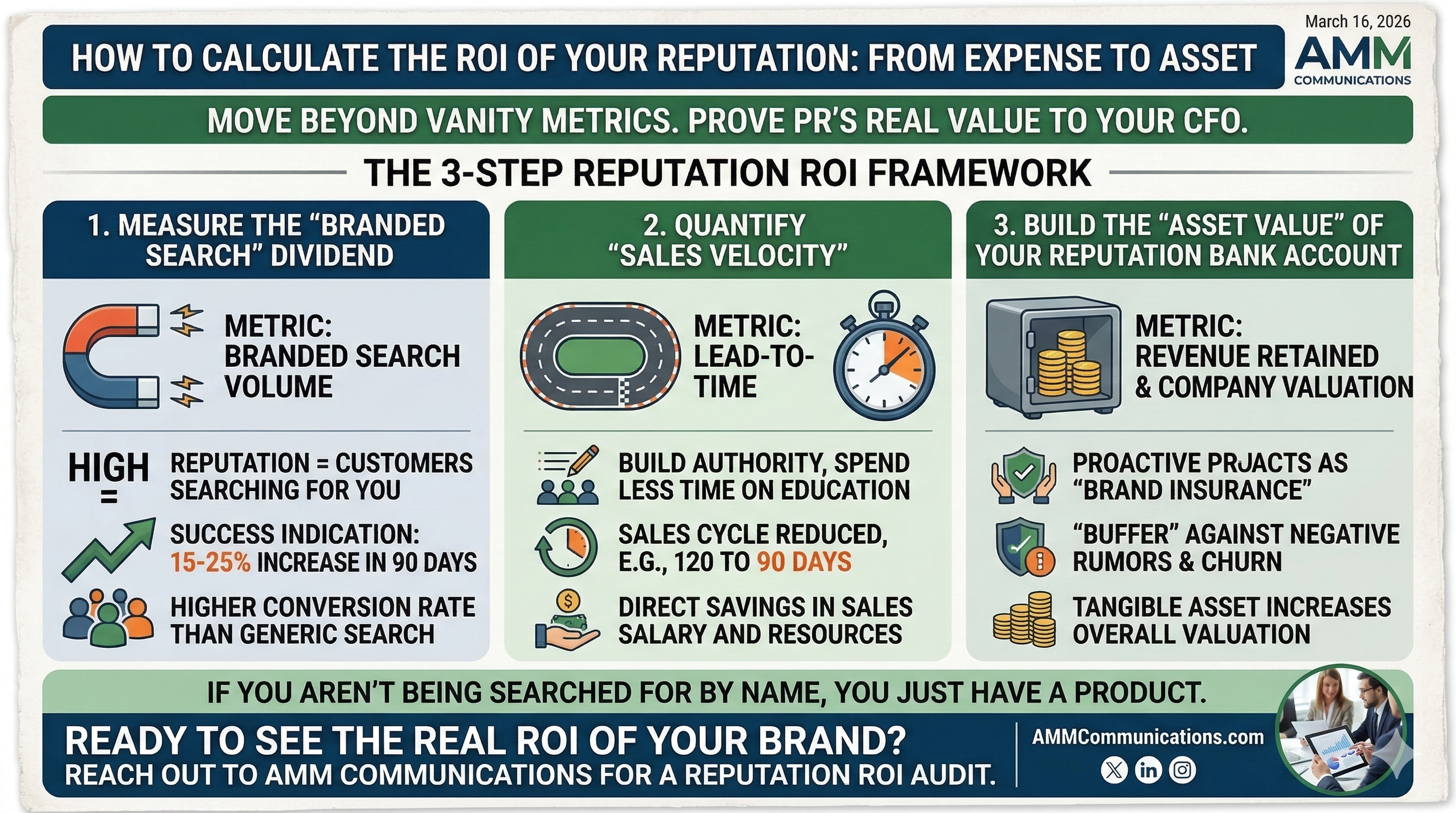
Step 1: Measuring the “Branded Search” Dividend
When your reputation is high, you spend less on “buying” traffic because customers are already actively looking for you.
The Measurement:
- Establish a baseline: use Google Search Console or your SEO platform to track the monthly volume of branded search queries (searches that include your company or founders’ names).
- Track this metric quarterly, alongside your PR activity calendar.
- Calculate the cost-per-click equivalent of that organic branded traffic. If 500 people per month search your firm by name, and the CPC for comparable keywords is $15, that’s $7,500/month in search advertising you’re not paying for — directly attributable to brand awareness driven by earned media.
This is a concrete, auditable number that a CFO can accept as return on PR investment.
Step 2: Quantifying “Sales Velocity”
How much time does your sales team spend “explaining” vs. “closing”? This is where PR’s ROI becomes visceral.
The Measurement:
- Survey your sales team with one question: “Before a prospect agreed to a discovery call, had they already encountered our brand in a news article, podcast, or editorial?”
- Track the average sales cycle length for deals where the prospect arrived “pre-warmed” by earned media versus “cold” prospects who had no prior brand exposure.
- Calculate the revenue impact of a shorter sales cycle. If a 10% reduction in average sales cycle length means your team can handle 10% more deals per quarter, what does that mean in revenue terms?
At AMM Communications, we have seen clients reduce their new-business sales cycle by 30–40% within six months of a consistent earned media program. For a professional services firm with a 90-day average sales cycle and a $150,000 average engagement, that compression has enormous dollar value.
Step 3: The “Asset Value” of the Reputation Bank Account
A proactive PR strategy acts as Brand Insurance. This is the hardest metric to quantify — until the moment you need it.
The Framework:
Think of your reputation as a bank account. Every positive media placement, every thought leadership article, every award and recognition makes a deposit. These deposits create a “goodwill reserve” that can be drawn on in a crisis.
Without a positive reputation reserve, a single piece of negative coverage, a disgruntled employee review, or a competitor’s attack can disproportionately damage your business. With a strong reservoir of earned media and community goodwill, the same negative event is absorbed and contextualized by the pre-existing positive narrative.
Assign it a dollar value: What would a reputational crisis cost you in lost contracts, new business delays, and defensive PR fees? For a $20M firm, a meaningful reputational crisis can cost 10–20% of annual revenue. A proactive PR retainer that prevents that scenario has a measurable insurance value.
The Reporting Framework That Actually Works
Replace “impressions” with these four numbers in your monthly PR report:
- Branded Search Volume: Monthly trend (up or down vs. prior period)
- Sales Cycle Length: Average days from first contact to close, segmented by “media-warmed” vs. cold leads
- Share of Voice: Your media mentions vs. top three competitors in your market (available via AgilityPR or Meltwater)
- Reputation Reserve Score: A rolling tally of positive placements, awards, and community recognitions — your balance in the Brand Insurance account
When you present these four numbers to your leadership team, PR stops being a line item to cut and starts being a lever to pull.
Want to see the real ROI of your brand? Reach out to AMM Communications for a Reputation ROI Audit. We’ll look at your current data, benchmark you against your competitors, and build a measurement framework that makes your PR investment undeniable.